
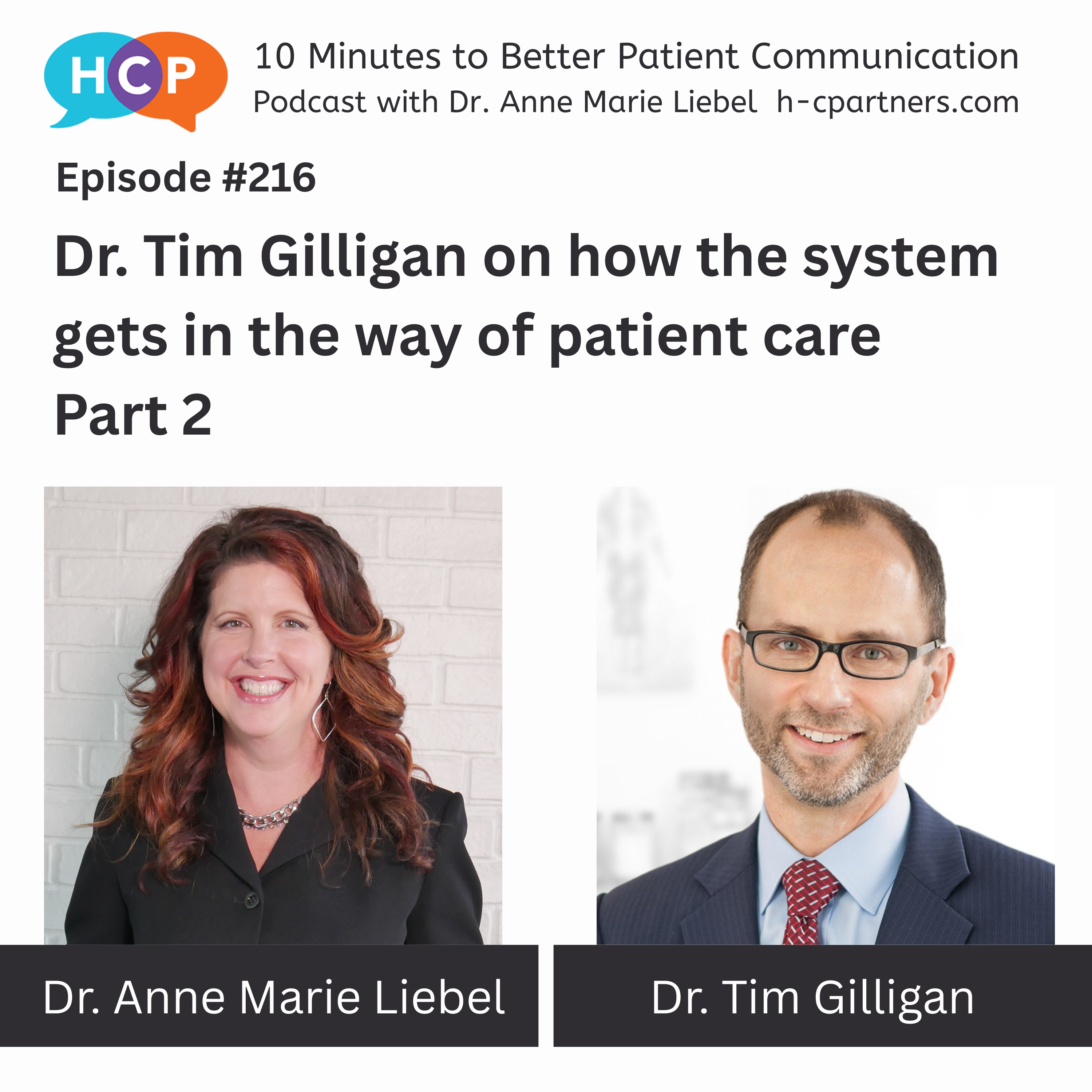

In Part 1 of my conversation with Dr. Tim Gilligan, Dr. Gilligan talked about some of the systemic issues that separate patients from providers and make communication difficult in health care. In Part 2, you’ll hear how communication helps Dr. Gilligan manage some of these systemic obstacles.
Hi, everybody. This is 10 Minutes to Better Patient Communication from Health Communication Partners. Since 2017, we’ve been giving you inspiration and strategies to improve engagement, experience, and satisfaction. I’m Dr. Anne Marie Liebel, a researcher, consultant, and educator specializing in communication and education. This podcast makes space to dig into what it’s easy to take for granted about communication in our professional lives, especially in health care and public health, but increasingly across sectors, because communication touches everything. We’re here to learn, get inspired, and most importantly, make the difference we got into our jobs to make. Like what you’re hearing in these episodes, want to take it further? Work with me. Visit healthcommunicationpartners .com and click on contact.
Yes, I got to sit down with Dr. Tim Gilligan. He’s the president of the Academy of Communication in Healthcare and a medical oncologist at Cleveland Clinic. And he talked about how when providers are pushed away from patients, care quality suffers. Now, off mic, Dr. Gillian told me, he knows he’s not saying anything you don’t already know. He mentioned that his brother, who’s also a physician, was told long ago, “When in doubt, go examine the patient. If you’re confused, things aren’t going the way you expect. Go to the bedside. Don’t go to the computer,” he said. “You’ll find important answers there at the bedside.”
I had another physician on the show some time back who made a similar point. Hematologist Dr. Lachelle Dawn Weeks told me, “You can lose track of the people that you came to work to care for.” So in her residency, she did something she called Social Rounds. when she would “Just go around and talk to my patients and see who they were and see if they needed anything and check on them.”
So I’ll link to that episode in the show notes as well as to part one of my conversation with Dr. Gilligan. In both of these conversations, I thought: it seems like it’s an act of resistance to be at a patient’s bedside. I wonder what you think. Visit healthcommunicationpartners .com or find me on LinkedIn and let me know. So let’s turn to Dr. Gilligan and an important conversation with a patient that has stayed with him.
P.S. Sign up here for the Academy of Communication in Healthcare’s 2026 ENRICH program!
Dr. Gilligan: Making sure I’m not spending too much time at the computer and the chart at the expense of being present with them.
Anne Marie: It just seems like that’s something that, I think, you’re probably reminding a lot of the audience of something they already knew and already value. And that’s looking at the patient, spending time with the patient.
TG: And the thing that stands out to me is how patients have really important information. And there’s an unfortunate habit now of cutting and pasting from past notes and past admissions, and people trying to learn everything they can about the patient by reading their chart, as opposed to learning about the patient by talking to the patient. and I’ve seen major omissions in the documentation or the understanding that people I work with have of patients because they haven’t actually asked the patient what’s going on. And when I’ve trusted what I’ve read, and then tested it against the patient, oftentimes that a lot of what I read is wrong. That it was mistranscribed or was a typo or someone just had a misunderstanding. And that if you go and ask the patient, you can get really important information, not just about how they’re feeling and how doing, but they know their past a lot of the time and there are pieces of it. I mean, you need both. There’s stuff in the record that the patient doesn’t know that you need to know as well, obviously. But it’s recognizing the importance of the information the patient has to share with us verbally that has been a really important thing to me to realize for myself and to try to emphasize to the people I teach.
AM: And thank you for teeing me up for my follow-up question to that is like, what have you learned from facing this issue in this way? Because you’re saying you’re facing the issue by spending more time with patients, going back in and following up with patients, testing what you see in the record against what the patient is actually telling you paying attention to those details. What are you learning from this process?
TG: What I’m really learning is that I can get better outcomes and take better care of my patients when I show up that way. I had one of my favorite cases was several years ago. I had an African -American woman who came to see me and I read in her chart that she’d been diagnosed with her cancer actually a year and a half or two years ago and had decided not to get treatment because it said in the chart she was a foster mother and wanted to spend time with her children. I thought, no mother wants to die of cancer and abandon her children. I’m a dad, that’s my nightmare, that I’ll get sick and die and I won’t be there for my kids. That made no sense to me but I puzzled, and I went into the room and started talking to her, and I could tell she really didn’t trust me at all. So I tried to say as little as possible. I just really listened carefully.
And she got to the point where she said, well, you know Dr. Gilligan. I was actually diagnosed a year and a half ago. And I said, I know, I saw that in your chart. Tell me what happened. She said, well, I was all set to go to surgery and have my bladder removed. And this anesthesiologist came into the room. And she just looked at me like I was a piece of dirt. And she stood at the doorway and she wouldn’t answer my questions. And I said, I don’t trust you to take care of me, so I canceled the surgery.
And then she left that system and came into our system, and her new urologist referred her to me. But what I learned in that experience was that I really watched her carefully and I listened carefully and I was really careful not to say anything wrong. I felt like it was so easy to say the wrong thing. The safest thing was really just to listen.
Then we got to that point, she told me that story, and I said to her something I’d never said to a patient before. I said, was that racism? And she said, yes. And I said, it sounds like racism. And she said, I know it when I see it. And after that, her total demeanor changed. And suddenly this distrust and suspicion of me started to change. I’m not saying it changed in an instant, but it clearly started to change at that point.
And we made a plan and she was going to see a another surgeon about having her bladder removed and a radiation doctor about maybe treating with radiation therapy. we talked through all of that and what was really touching to me was when she was leaving she said now i know why doctor such and such referred me to see you. but i didn’t leave it at that like i’ve seen all this distrust. So I knew she was seeing these other two doctors. So I actually called her at home several days later. I said, I saw that you saw these other two doctors. Tell me what happened.
And she said, well, I’m not going to let that guy operate on me. I said, why not? She said, he just couldn’t wait to wheel me into the operating room. So we came up with a plan for radiation therapy, which I actually think was a better plan for her anyway. And, and, you know, last I saw, you know, several years after treatment, she had been cured. So we had somehow, despite the delay in her treatment, managed to cure her. But I thought it took a lot of paying attention to seeing who she was, that she’d had a bad experience in the system and didn’t trust the system. And listening carefully and watching carefully and trying to be responsive to what I was seeing, was a way to build trust. And once I built some trust, we could then get her through. And the treatment she went through was not an easy treatment to go through. I mean, it’s five days a week of radiation therapy for at least four weeks and there’s some minor surgical procedures and chemotherapy. And I mean, it’s a lot to go through and we got her through it. And I don’t know that we would have without building that trust at the beginning.
AM: Wow. Well, Tim, thank you for that story. I’m thinking about how just those last couple sentences really the contrast between all of the science and all of the medicine and even the technology that was involved in her treatment, being able to access that and use it and have it work came down to a conversation between the two of you. And that for me draws the line I think you are trying to draw for us between what an individual can do inside the systemic confines that you’ve got.
TG: Yeah, absolutely, right? I mean, I can’t fix racism. I can’t make it go away. I can’t make our health system completely unbiased, but I can, one patient at a time, try to have a good conversation and show respect and build trust.
AM: And what kind of an impact that had on the outcome for that patient. I think about too, like trying to–one of my earliest conversations, when I finally was starting to cross over from the education sector into the health sector, was with an anesthesiologist. And they were feeling very crushed by the system. And we talked about communication as a way of getting back to the reason he got into this to begin with. And that has stuck with me.
I can’t make our health system completely unbiased, but I can, one patient at a time, try to have a good conversation and show respect and build trust.
Dr. Tim Gilligan
TG: I think that’s so centrally important. I honestly, I don’t wanna sound Pollyanna-ish, but I think we’re so lucky we get to work in healthcare because we get to do meaningful work. I go home at the end of the day and I feel like I took care of sick people. I took care of people’s health today. Like that’s work that’s worth doing. I’m lucky that I get to do work that feels so meaningful. And I’m not, I think all work can have value. And I don’t mean to say that like my job’s more important than anyone else’s job. But the point is that it has meaning to me.
And that’s one thing I can anchor myself in when I go to work is I’m getting to do work that’s meaningful to me. I may have difficult work conditions. There may be a lot of frustrations. There are plenty of negative things I could list. And if I can keep my eye on the ball and remember why I wanted to go to medical school in the first place, and why I work so hard in residency and fellowship and that I’m getting to do what I wanted to do. And there are a lot of people on planet Earth who don’t get to do that. And Again, it doesn’t mean that we should just forget about all the things that are difficult or not want to change it, but it’s, I think we sometimes lose track of the fact that we also are very privileged to get to do this work. And it’s, again, that’s not in any way an argument against trying to change the system and fix the system, but it’s how I survive in the system while I hope it will change and try to work to change it.
AM: Dr. Tim Gilligan, thank you so much for spending time with us today.
Thanks to Dr. Gilligan for spending time and for sharing several stories. There’s a lot to his stories. I wonder what they got you thinking about. He had said in pre-roll that the conversation that he shared in this episode with a patient was the highlight of his year. He said it’s what he got into this to do, and it made it worth getting out of bed in those days. He and I agree, this is one of the many benefits to strong patient physician communication beyond the most important, better patient outcomes. It’s reconnecting with why you got into this job to begin with. If this is important to you, I’d love to work together. Visit healthcommunicationpartners .com to learn more. This has been 10 Minutes to Better Patient Communication from Health Communication Partners. Audio engineering and music from Joe Liebel, additional music from Alexis Rounds. Thanks for listening to 10 Minutes to Better Patient Communication from Health Communication Partners LLC. Find us at healthcommunicationpartners .com.